
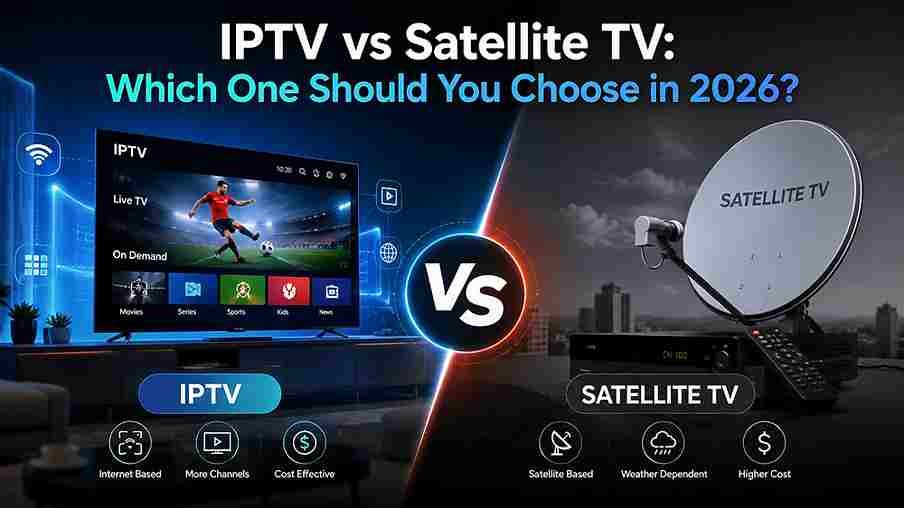
Thinking of switching from a dish or a cable box to streaming? The IPTV vs satellite TV UK question comes down to how you want to pay, which devices you use and how much you rely on your broadband.
This guide compares IPTV with satellite and cable TV across the factors that matter most. We also say where satellite and cable still win, because the right choice depends on your household.
Last updated: October 2026
How Each Option Works IPTV vs Satellite TV UK
Satellite TV sends signals from a satellite to a dish on your home, and a set-top box turns them into channels. You usually need an installation visit.
Cable TV delivers channels through a fixed cable network into a box, often bundled with broadband and a landline.
IPTV (Internet Protocol Television) delivers live channels and on-demand content over your broadband. You watch through an app on a device such as a Firestick, Smart TV, phone or tablet, with no dish and no cable installation.
IPTV vs Satellite vs Cable at a Glance
| IPTV | Satellite | Cable | |
|---|---|---|---|
| Delivery | Your broadband | Dish and set-top box | Cable network and box |
| Installation | App on your own device | Usually an engineer visit | Usually an engineer visit |
| Contracts | Varies, often flexible | Often fixed-term | Often fixed-term |
| Channel choice | Depends on the provider | Set by the package | Set by the package |
| Devices | Many (Firestick, Smart TV, phone) | Mainly the box | Mainly the box |
| Needs good broadband | Yes | Not for live TV | Bundled with broadband |
| Works in bad weather | Yes | Heavy rain can affect the signal | Yes |
Cost: How to Compare Fairly
Prices and offers change often, so check current figures before you decide. To compare properly, add up the full cost of each option:
- Monthly price multiplied by the contract length
- Add-ons for sports, cinema or extra channels
- Equipment and installation fees, if any
- Mid-contract price rises and what happens when your deal ends
- Streaming apps you’d still pay for separately
Then compare it with the IPTV plan you’re considering. As an example, our 12-month plan is £49.99, which works out at roughly £4.17 a month. Make sure you compare like with like: the channels, quality and support you actually get matter as much as the headline price.
IPTV vs Satellite TV UK Channels and Content
Satellite and cable offer fixed packages: you pick a tier, and the channel list is set. That’s simple and predictable, but extra sports or cinema usually cost more.
IPTV services tend to offer a much larger and more international channel list, plus on-demand libraries, so they suit households that want UK television alongside channels from other countries. The exact lineup depends entirely on the provider, so check the channel list before you subscribe.
Picture Quality
All three can deliver HD and 4K. Satellite and cable have a stable, dedicated signal. IPTV depends on your broadband speed and the provider’s servers. As a general guide, you need around 10 Mbps for HD and 25 Mbps or more for 4K per stream, and a wired connection helps. If you notice freezing, our IPTV buffering fix guide covers the most common causes.
Contracts and Flexibility
Satellite and cable deals are often fixed-term, so leaving early can mean paying fees. IPTV subscriptions are often available for shorter periods (for example 3, 6 or 12 months) without automatic renewal, but terms vary by provider. Always read the renewal and refund terms first.
Sports and Live Events
Live sport is where it pays to be careful. Sports rights in the UK are sold to specific broadcasters, so official packages are the way to be sure you’re watching content a provider is licensed to show. If you’re considering IPTV for sport, check who your provider is, ask what’s included and be wary of offers that sound too good to be true.
Devices, Setup and Flexibility
Satellite and cable are tied mainly to the box connected to your TV, with extra boxes or apps for other rooms. IPTV runs on devices you already own, so you can watch in the living room, in bed or on the go with the same login, as long as your plan allows it. Setup usually takes minutes: see our IPTV Firestick setup guide for the steps.
Reliability
Satellite and cable don’t depend on your home broadband for live TV, which is a real advantage if your connection is patchy. IPTV depends on your internet and on the provider, so a stable connection and a provider with responsive support matter. If you don’t trust your broadband yet, test an IPTV trial alongside your current service first.
Which Option Suits You?
IPTV may suit you if:
- You want a flexible plan without a long contract
- You like watching on several devices
- You want international channels
- You have reliable broadband
Satellite or cable may suit you if:
- Your broadband is slow or unreliable
- You want a simple box with official bundled sport and cinema
- You prefer a single provider for TV and broadband
IPTV vs Satellite TV FAQ
Is IPTV cheaper than satellite TV?
It often can be, but compare the full cost of both, including add-ons, equipment and contract terms, and what’s actually included.
Does IPTV have the same picture quality as satellite?
IPTV can deliver HD and 4K. The quality depends on your broadband, your device and the provider.
Do I need a contract for IPTV?
Not always. Many IPTV plans are for a fixed period without automatic renewal, but it varies, so check the terms.
Can I keep my broadband provider?
Yes. IPTV works over your existing broadband, so you don’t need to change it.
Is IPTV legal in the UK?
IPTV is a delivery method, and many licensed services use it. Whether a service is lawful depends on whether it has the rights to the content it streams, so check your provider and take legal advice if you’re unsure.
Try IPTV Alongside Your Current TV
The best way to decide is to test it. Keep your satellite or cable running and try an IPTV subscription UK viewers can test first. You can start our 24-hour free trial on your own connection, and our support team is available 24/7 if you need help.