

IPTV Subscription UK On a typical weekday evening in a British home, the living room is rarely a single-screen affair. Someone is catching up on the news at the kitchen counter, a teenager is curled over a tablet upstairs, and a parent is hunting for twenty uninterrupted minutes in front of the big screen. Nobody is doing anything wrong. The household has simply outgrown the idea that one television, one schedule and one remote can keep everyone content.
That quiet shift explains why so many people now look at an IPTV subscription UK families can fold into their daily routines, rather than treating it as a gadget for one person in one room. The question is no longer “what is on?” but “how will this fit around the way we actually live?”
This guide takes a lifestyle view of the subject: viewing habits, devices and daily rhythm, not rankings or sales patter. If you are weighing up a dedicated IPTV Subscription UK service, the aim is to help you judge whether it suits your home before you commit to anything.
How UK Households Watch Television Differently Today

Television used to be an appointment, with the schedule dictating the evening. Today the living room is only one of several places where viewing happens. The kitchen has a screen, the bedroom has a screen, and the phone in your pocket quietly acts as another. IPTV, which simply means television delivered over an internet connection, fits naturally into that pattern.
Picture a Tuesday in a Three-Generation Home
Imagine a household where the grandparents prefer a familiar programme on the main television at teatime, a teenager studies with something playing quietly on a laptop, and a parent arrives home wanting to watch on a tablet while dinner finishes. This is an illustrative scenario rather than a case study, but it will feel familiar to many UK homes.
What links these routines is flexibility. Each person wants to watch what they like, on the screen that suits the moment, without negotiating a rota. A well-matched IPTV subscription UK viewers choose with that in mind should make the home calmer, not busier.
Different Viewing Preferences Within the Same Household
Understanding IPTV viewing habits starts with admitting that no two people under your roof watch alike. Some dip in and out through the day. Others settle in for an entire evening. Some want the largest screen available, while others want whatever is within reach.
Before you shortlist any IPTV subscription UK providers offer, sketch out who watches, when and where. A few familiar patterns:
- The early riser who puts something on while getting ready for work.
- The after-school viewer who reaches for a tablet or smartphone.
- The evening anchor who wants the main television for shared viewing.
- The late-night viewer who needs a personal, quiet screen.
- The occasional guest who simply needs something straightforward.
Mapping these habits is the foundation of IPTV for different household needs. The table shows how routines translate into priorities.
| Household member | Typical viewing moment | Likely screen | What matters most |
|---|---|---|---|
| Working parent | Early morning or late evening | Smartphone or tablet | Quick access and easy navigation |
| Teenager | After school and weekends | Laptop, tablet or phone | Portability and independent viewing |
| Grandparent | Afternoon and teatime | Main television | A clear picture and simple controls |
| Whole family | Weekend evenings | Largest screen in the home | Reliability and shared viewing |
Why Simultaneous Connections and Device Flexibility Matter
If the household is the story, devices are the cast. Smart televisions, tablets, laptops, phones and streaming boxes all compete for attention, so IPTV for multiple devices is often the first practical question families ask.
Here is the part that trips people up. Owning many devices does not mean they can all stream at once. Those are two separate things, and your daily experience depends on both.
Supported Devices vs Simultaneous Connections: The Short Answer
IPTV Subscription UK Supported devices are the types of screens a service can work on. Simultaneous connections are the number of those screens that can stream at the same moment under one subscription. A service may work on many kinds of device yet allow only a limited number of active streams, so always confirm both with the provider.
| Term | What it means | Why it matters at home |
|---|---|---|
| Supported devices | The kinds of screens or hardware the service is designed to work with | Shows whether your existing televisions, tablets and phones can be used |
| Simultaneous connections | How many screens can stream at the same time on one subscription | Shows whether two or three people can watch different things together |
| Installed devices | Devices on which you have set up access | Setting up six devices does not mean six can stream together |
For a busy home, the middle row matters more than most people expect. A household with two regular evening viewers has very different needs from one with five. When comparing any IPTV subscription UK plan, ask for the exact number of simultaneous connections and get it confirmed in writing rather than assuming.
Flexible Viewing Around Busy Family Routines

Interest in a flexible IPTV subscription UK households can rely on usually comes from routine, not novelty. Life is scheduled in fragments: the school run, the after-club tea, the shift pattern, the weekend that never quite stays empty.
Viewing needs to bend around those fragments. That might mean watching on a phone while waiting at the school gate, picking up on a tablet at the kitchen table, then moving to the main television once the house is quiet.
IPTV Subscription UK Consider a hypothetical family whose evenings never quite line up. One parent works late, so the other watches alone earlier on, and the couple regroups on the sofa later. The value on show is not volume. It is the freedom to watch where and when it suits.
Keeping Home Viewing Simple
Watching at home should never demand a technical degree. The best arrangements tend to be the quiet ones: familiar screens, straightforward navigation and no daily troubleshooting. An IPTV subscription UK homes can use comfortably is one that the least technical person in the house can operate without calling for help.
- Choose a setup that suits the most cautious technology user at home.
- Keep separate apps and logins to a sensible minimum.
- Check your internet connection copes at your busiest time.
Choosing an IPTV Subscription: What UK Households Should Consider First
Searching for the best UK IPTV is understandable, but “best” is personal. The right choice for a couple in a flat is rarely right for a household of six. Choosing an IPTV subscription UK homes will enjoy starts with your household, not a list of features.
| Consideration | Why it matters | Question to ask |
|---|---|---|
| Simultaneous connections | Decides how many people can watch at once | How many screens can stream together on one subscription? |
| Device compatibility | Confirms your existing screens can be used | Which types of device are supported? |
| Internet connection | Several streams share the same home bandwidth | Is our connection comfortable on our busiest evening? |
| Support | Helps when something does not work as expected | How and when can we contact the provider? |
| Terms and clarity | Prevents unwelcome surprises later | Are plan terms, renewal and usage rules clearly stated? |
IPTV Subscription UK services differ in how they are set up and supported, so match the service to your routine, not the other way round. An IPTV subscription for families, in particular, has to satisfy several people at once.
A Reliable Starting Point for Households Researching UK IPTV
When you are researching an IPTV subscription UK residents can trust, the sheer volume of scattered information can be exhausting. It helps to have one central place to return to, where the service is explained clearly and in terms that make sense for British homes.
That is why the main website, which presents an IPTV subscription UK households, is a sensible reference point. Read how the service is described, measure it against your own checklist, and come back to it as your questions develop.
Going Deeper: Technical References Worth Reading
Not every question about IPTV is a lifestyle question. Some are technical: how playback software behaves, how streams are handled across devices, which settings can affect performance. Relevant external references can help readers understand those principles more deeply.
For readers who enjoy the detail, technical background on IPTV player software can add context alongside this guide. As with any external reference, read it critically and compare it with what your own provider tells you.
How to Assess Whether a Subscription Suits Your Daily Routine
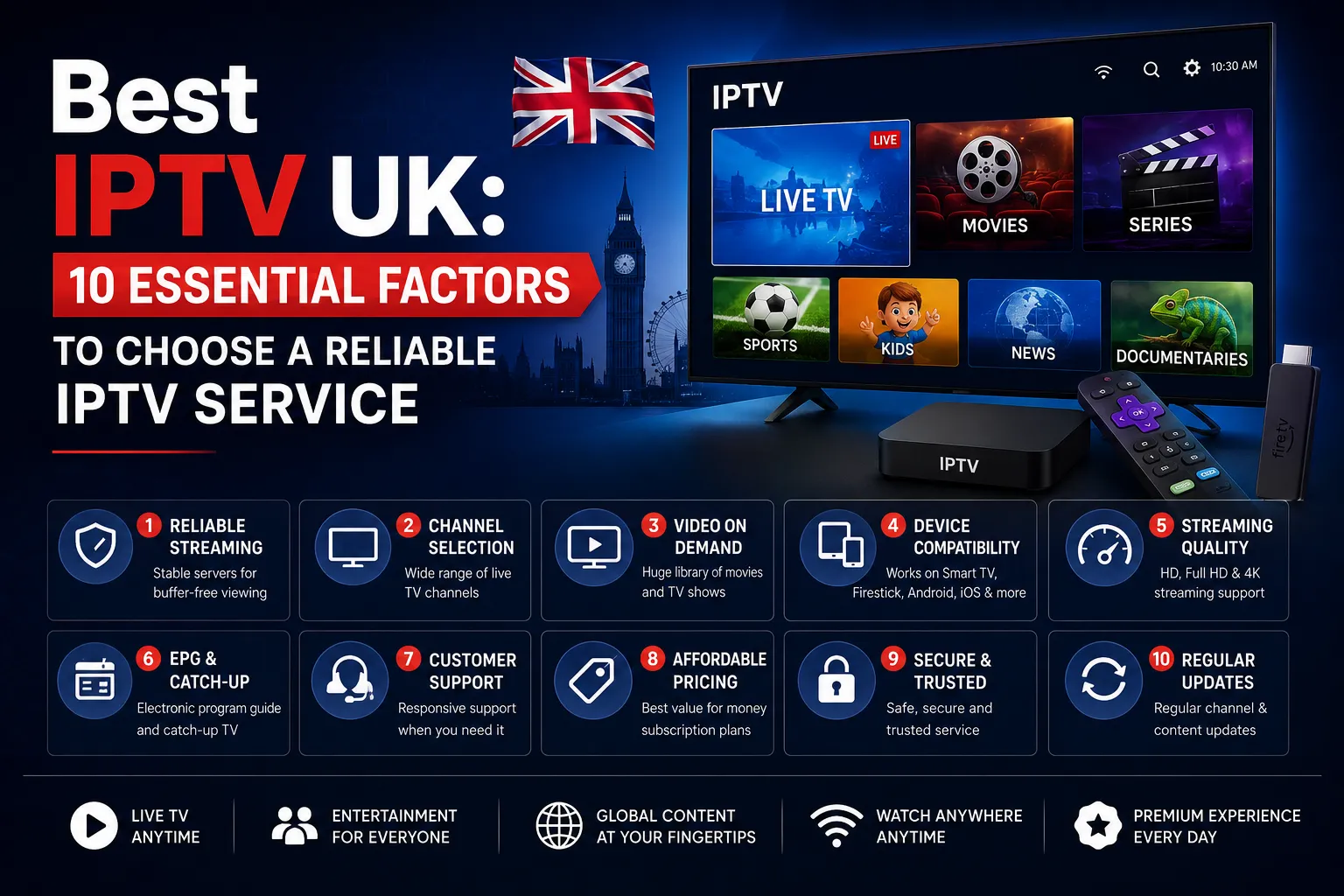
You only need an honest conversation at the kitchen table. Work through these steps with everyone present:
- List who watches, when and on which screen across a typical week.
- Identify your busiest viewing moment and count how many screens are in use at once.
- Note the devices already in your home and who uses each one.
- Check that your internet connection can cope with that busiest moment.
- Ask the provider to confirm supported devices, simultaneous connections and support arrangements in writing.
The exercise takes about ten minutes and usually reveals more than any feature list. If an IPTV subscription UK households consider still looks right after those five steps, you are choosing with confidence rather than hope.
Conclusion: Choose for the Home You Actually Live In
The right IPTV subscription UK families choose is rarely the one with the loudest promises. It is the one that disappears into daily life, quietly serving the early riser, the teenager, the grandparent and the weekend crowd alike.
The key takeaways are simple:
- UK households watch in different ways, at different times, on different screens.
- Supported devices and simultaneous connections are not the same thing.
- Flexibility around family routines matters more than sheer volume.
- The best choice is the one that fits your household’s habits, not a generic idea of “best”.
Your next step is straightforward. Map out your household’s week, write down your busiest viewing moment, then take that list to the main website and see how a UK IPTV subscription measures up against it. A good fit should feel effortless from the very first evening.
FAQ
How can an IPTV subscription fit different household viewing habits?
By giving each person flexibility over where and when they watch. Start by working out who watches what and when, then confirm that the supported devices and the number of simultaneous connections match your routine. A well-chosen IPTV subscription UK households use should feel invisible in daily life.
Can multiple family members use IPTV on different devices?
Often, yes, depending on the plan. Whether they can do so at the same time depends on the number of simultaneous connections, so check that figure with the provider before relying on it.
What is the difference between supported devices and simultaneous connections?
Supported devices are the types of screens a service works on. Simultaneous connections are how many of those screens can stream at the same time under one subscription. Having a device set up does not guarantee it can stream while others are in use.
What should UK households consider before choosing an IPTV subscription?
Think about simultaneous connections, device compatibility, your home internet connection, the support available and how clearly the terms are explained. For an IPTV subscription UK families can rely on, the best starting point is always your own household’s viewing habits.
Can an IPTV subscription work for different screen sizes around the home?
Many services are designed to work across a range of screens, from phones to large televisions, but it depends on the devices supported. Check the compatibility details for the specific screens in your home before deciding.
How can you decide whether a subscription suits your daily routine?
Map your household’s typical week, identify the busiest viewing moment, and ask the provider to confirm devices, connections and support. If it matches how your home actually works, with an IPTV subscription UK routines can lean on, it is likely a good fit.